Flowguard
Automating enterprise transaction verification through intelligent workflows and API-driven validation.
Duration
3 weeks
Tech Stack

Draw.io

ChatGPT

Claude
Role
Product Intern
Project Overview
A critical enterprise workflow relied on manually verifying transaction commitments against supporting records received later in the process. As transaction volumes grew, operational teams spent significant effort validating data, investigating discrepancies, and coordinating across systems.
The goal was to redesign this process into a scalable, automated framework capable of validating records in real time, flagging inconsistencies, and enabling faster operational decision-making.
The Problem
The verification process depended heavily on manual reviews and cross-system checks, creating delays and increasing operational overhead.
Key Pain Points
Repetitive manual validation activities
Delayed identification of discrepancies
Limited visibility into verification status
Increasing operational effort as volumes scaled
Research & Discovery
Through stakeholder workshops, process mapping, and workflow analysis, I examined how verification activities moved across business, operations, risk, and technology teams.
Key Insight
Most delays originated from manual comparison of transaction data against supporting records. A structured verification framework combined with API-based integrations presented a significant opportunity to reduce operational effort and improve control.
Opportunity
How might we automate transaction verification while maintaining accuracy, control, and scalability?
Success Vision
Create a system capable of automatically validating records, identifying exceptions, and routing cases for review only when human intervention is required.
Solutions
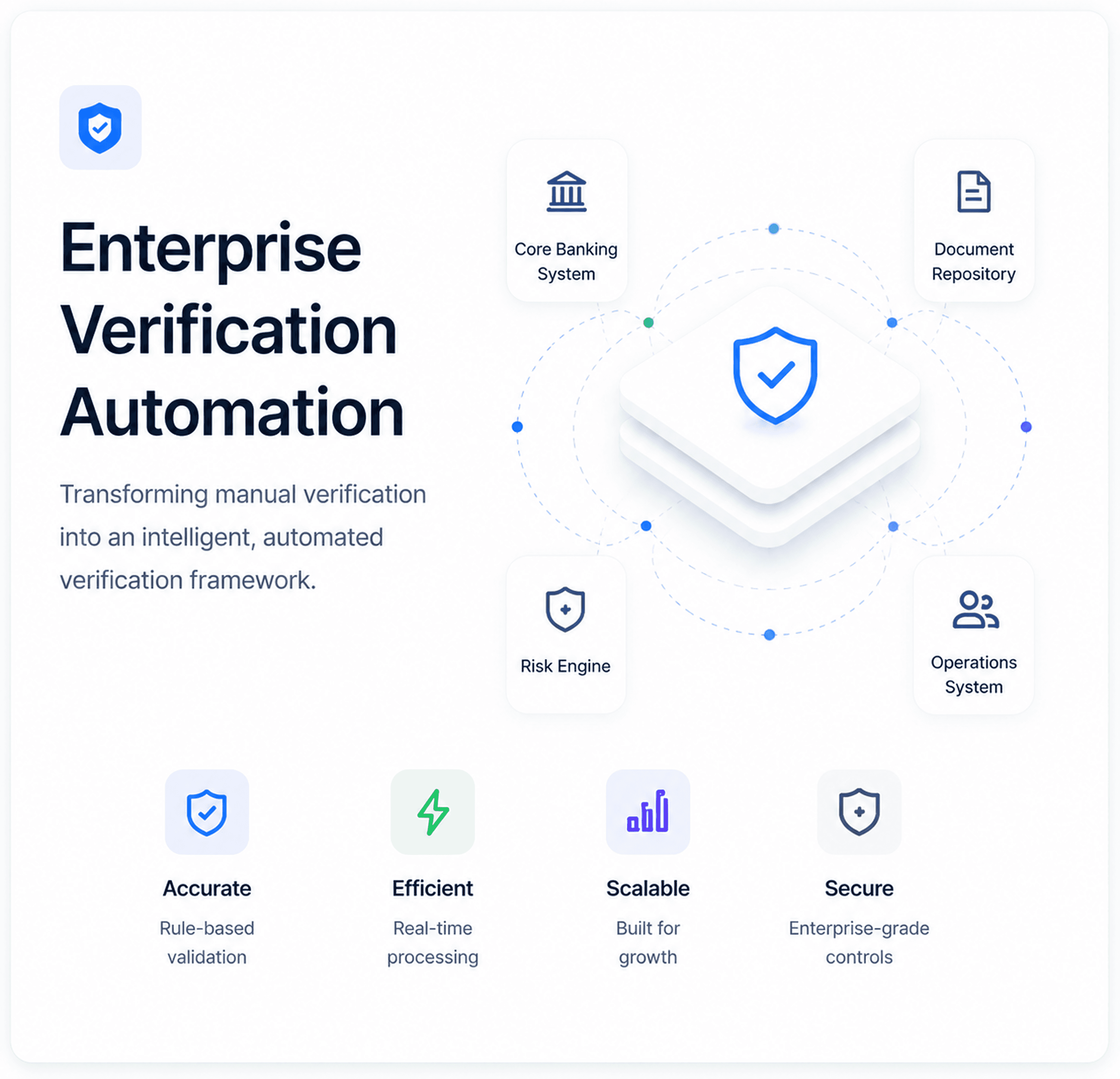
Design Approach--Designed an intelligent verification framework powered by API integrations, automated validation logic, and exception-based workflow routing.
Automated Data Exchange--Enabled system-to-system integrations for seamless data ingestion and verification.
Intelligent Matching Engine--Designed validation rules to compare incoming records against predefined business conditions and identify inconsistencies automatically.
Exception Management--Designed an automated system to flag mismatches (such as date issues) and route them to designated Risk Reviewers.
Risk-Based Routing--Defined decision logic to route transactions based on validation outcomes and business rules.
Operational Visibility--Enabled real-time tracking of verification status, exceptions, and workflow progress.
Key Challenges
The primary challenge was balancing automation with operational control. The workflow needed to reduce manual effort while ensuring exceptions were surfaced accurately and handled through a structured review process.
Outcomes & Reflections
Achieved 90%+ straight-through processing (STP) by automating transaction verification and validation workflows.
Reduced manual review effort by over 90%, requiring human intervention only for exceptional, high-risk, or failed validation cases.
Implemented automated fraud and anomaly detection controls that immediately restricted processing when invalid, suspicious, or non-compliant records were identified.
Eliminated manual cross-system verification through API-driven data exchange and automated matching logic.
Reduced operational dependency by enabling automated validation, exception handling, and risk-based routing.
Key Learnings
Automation is most effective when paired with strong exception handling
Operational transparency is critical for enterprise workflows
Successful workflow transformation requires alignment across multiple stakeholder groups